

- Product
Kindling
Product Overview
Sophisticated security with unmatched simplicityCloud SIEM
Pre-configured detections across your environmentHoneypots
Deception technology to detect lateral movementEndpoint Visibility
Real-time monitoring with added detection & responseSecurity Reports
Data visualizations, compliance reports, and executive summariesAutomated Response
Detect, prioritize, and neutralize threats around the clockIntegrations
Cloud, on-prem, and open API connectionsXDR Platform
A complete view to identify risk, and things operational
- Pricing
- Why Blumira
Why Blumira
The Security Operations platform IT teams loveWatch A Demo
See Blumira in action and how it builds operational resilienceUse Cases
A unified security solution for every challengePricing
Unlimited data and predictable pricing structureCompany
Our human-centered approach to cybersecurityCompare Blumira
Find out how Blumira stacks up to similar security toolsIntegrations
Cloud, on-prem, and open API connectionsCustomer Stories
Learn how others like you found success with Blumira
- Solutions
- Partners
- Resources
A recent high-priority notification lit up a customer’s Blumira dashboard: Password Spraying Detected. For this company’s lean but technically savvy IT team, this was a code-red event, but confusion set in when they saw the target: critical internal servers. Their firewall, while noisy from what looked like a standard Denial of Service (DoS) attack, wasn't reporting an internal breach. The team was staring at two different problems until they got on a call with Blumira's SecOps team. That's when they realized it wasn't two attacks, it was a highly sophisticated smokescreen.
The Challenge
The day began like any other for the client's IT team, until Blumira sent them a high-priority alert. The alert wasn't for a typical external probe; it was for password spraying targeting critical internal services.
This immediately raised alarms around how an attacker could be brute-forcing internal credentials, where it was coming from, and why it was happening. There were no other signs of a breach, and no other standard alerts had been triggered from the system. This single, high-fidelity alert from Blumira was the only indication that something was seriously wrong. The team needed to know not just what was happening but how.
The Investigation
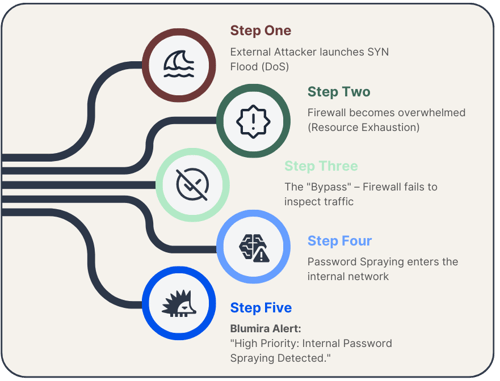 The customer’s IT staff immediately contacted Blumira’s 24/7 SecOps team through the Blumira app. Within fifteen minutes of reaching out, a senior security analyst began digging into all available log data, including the company’s firewall logs that, up to that point, had been "noisy" but hadn't triggered a specific, actionable alarm. The investigation revealed hundreds of blocked authentication attempts within minutes of each other originating from countries all over the world.
The team discovered that the firewall was being subjected to a massive Denial of Service (DoS) attack in the form of a SYN flood and IP spoofing.
The attacker was using the high-volume SYN flood as a smokescreen. The goal was to overwhelm the firewall, "tapping" its resources to the point where it could no longer effectively inspect all traffic. This created a firewall bypass, allowing the attacker to slip their true target, the password spraying attack, through the noise and directly onto the internal network.
The password spraying alert was the symptom. The DoS attack was the vector. Blumira’s ability to correlate these two seemingly separate events was the key to understanding the full attack chain.
The Solution
Once the complete attack was visible, the incident response plan was clear and immediate. Blumira's SecOps team guided the customer to:
- Block the Attack: The team immediately implemented firewall rules to block the malicious IPs responsible for the SYN flood, stopping the attack at its source.
- Secure the Entry Point: They identified that the attackers were targeting a vulnerable virtual office portal, which was promptly secured and locked down.
- Harden Defenses: Blumira provided further recommendations, including implementing geo-blocking policies and updating firewall configurations to be more resilient against future state exhaustion attempts.
The Results
This incident demonstrated a critical gap in traditional, perimeter-only security. The firewall, on its own, was so overwhelmed it didn’t even respond to the DoS attack, a common, low-context event. It was Blumira's threat detection and response platform, monitoring both internal and perimeter logs, that provided the critical internal threat and context to stop the breach. Without the system being set up for continuous logging, this may have gone unnoticed and resulted in a full breach for the client.
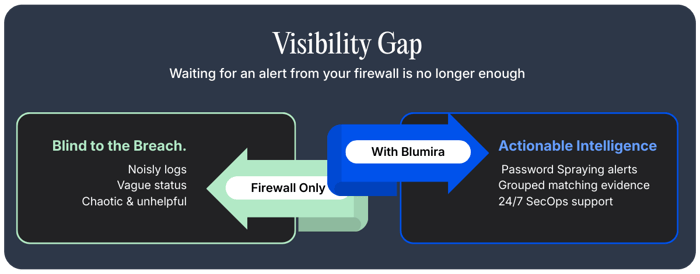 For this organization, which, like many, runs a lean IT team, Blumira’s solution acted as a force multiplier. It provided the notification and 24/7 expert analysis of a dedicated SOC, turning a confusing alert into a clear, actionable remediation plan. As a direct result of this real-world event, Blumira’s security engineers developed and deployed new detection rules to automatically identify this specific attack pattern, protecting all Blumira customers from this threat.
This is a powerful example of how attackers use multi-stage, complex threats to bypass traditional perimeter defenses. Waiting for the alert from your firewall is no longer enough. If you’re managing a lean IT team and need to ensure you have complete visibility across your environment, see how the Blumira Security Operations platform and 24/7 SecOps team can help you detect and respond to threats like this one.
Tag(s):
More from the blog
View All Posts
Blumira News
5 min read
| May 17, 2021
Blumira Expands Its Cloud Security Coverage With AWS Security Monitoring
Read More
Customer Success Stories
8 min read
| July 15, 2021
How AdvantageCS Secures Its SaaS Platform With Blumira
Read More
SIEM XDR
7 min read
| October 29, 2024
After the Sunset: Choosing Your Post-LogRhythm SIEM
Read More