

- Product
Kindling
Product Overview
Sophisticated security with unmatched simplicityCloud SIEM
Pre-configured detections across your environmentHoneypots
Deception technology to detect lateral movementEndpoint Visibility
Real-time monitoring with added detection & responseSecurity Reports
Data visualizations, compliance reports, and executive summariesAutomated Response
Detect, prioritize, and neutralize threats around the clockIntegrations
Cloud, on-prem, and open API connectionsXDR Platform
A complete view to identify risk, and things operational
- Pricing
- Why Blumira
Why Blumira
The Security Operations platform IT teams loveWatch A Demo
See Blumira in action and how it builds operational resilienceUse Cases
A unified security solution for every challengePricing
Unlimited data and predictable pricing structureCompany
Our human-centered approach to cybersecurityCompare Blumira
Find out how Blumira stacks up to similar security toolsIntegrations
Cloud, on-prem, and open API connectionsCustomer Stories
Learn how others like you found success with Blumira
- Solutions
- Partners
- Resources
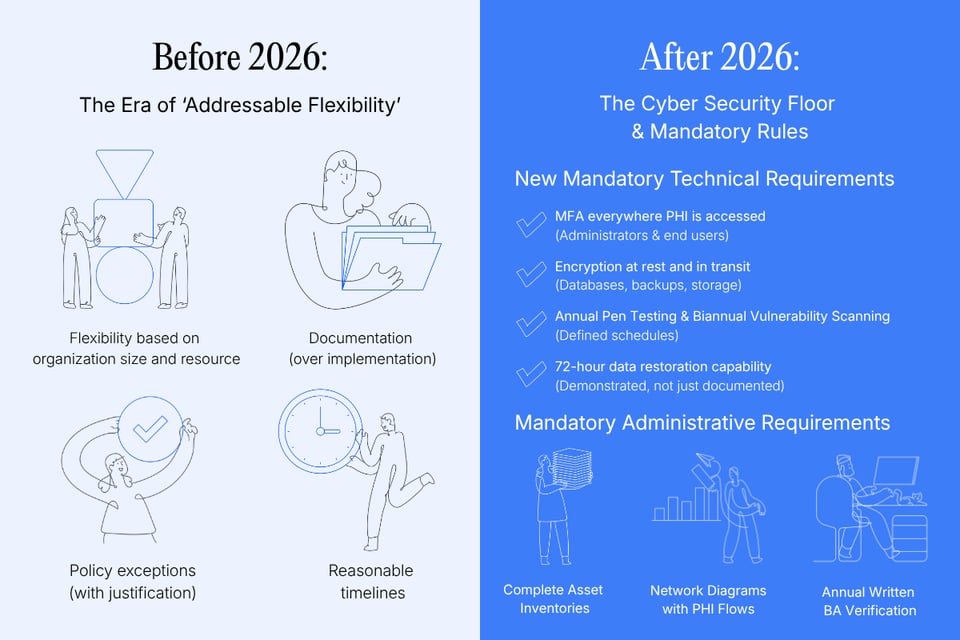
For years, HIPAA's Security Rule gave healthcare organizations a degree of flexibility. Certain safeguards were labeled "addressable" — meaning if a control wasn't practical for your organization, you could document why and move on. That era is ending.
The 2026 HIPAA Security Rule updates, driven by HHS in response to a sustained rise in healthcare ransomware and data breaches, eliminate much of that flexibility. The message from regulators is straightforward: documentation without implementation will no longer pass an audit.
If your security program still relies on policy exceptions or the assumption that smaller organizations get a pass, now is the time to reassess.
What's Actually Changing
The core shift is from "addressable" to mandatory. HHS has made clear that organization size is no longer a mitigating factor — the same technical safeguard requirements apply whether you're a regional hospital system or a small practice. Even for the 'limited exceptions' in cases of extreme technical impossibility, the bar for proving an exception has been raised significantly.
The four new mandatory technical requirements are:
-
MFA everywhere PHI is accessed. Multi-factor authentication must be enforced across all systems and applications that touch protected health information — for both administrators and end users. The "our vendor doesn't support MFA yet" explanation will no longer satisfy auditors.
-
Encryption at rest and in transit. Most organizations already encrypt data in transit. The 2026 changes make encryption at rest equally mandatory — covering databases, file systems, backups, and powered-off storage.
-
Annual penetration testing and biannual vulnerability scanning. These are distinct requirements. Vulnerability scans identify weaknesses; penetration tests actively attempt to exploit them. Both are now required on a defined schedule.
-
72-hour data restoration capability. Organizations must be able to demonstrate — not just document — that they can restore critical systems within 72 hours of an incident. Paper disaster recovery plans aren't sufficient anymore.
On the administrative side, organizations are also now required to maintain complete asset inventories and network diagrams showing where PHI flows, follow standardized configuration management practices, and obtain annual written verification from business associates confirming their technical safeguards are actually in place.
Why Monitoring and Detection Are At The Center
Several of the 2026 requirements converge on a common capability: knowing what's happening in your environment in real time.
HIPAA Section 164.308(a)(1)(ii)(D) requires procedures to regularly review audit logs, access reports, and security incident tracking. Section 164.312(b) requires hardware, software, or procedural mechanisms that record and examine activity across systems containing ePHI. Login monitoring — previously addressable — is now a required procedure.
Together, these controls describe exactly what a SIEM is designed to do: collect logs from across your environment, analyze them automatically, surface anomalies, and provide an auditable record of what happened and when.
Where Blumira Fits Into HIPAA Compliance
Blumira's SIEM + XDR platform directly addresses the monitoring, logging, and detection requirements that sit at the heart of the 2026 changes.
Audit log collection and review. Blumira integrates with your cloud and on-premises systems — EHR platforms, endpoints, network devices, identity providers — and centralizes logs across all of them. Every finding is populated with the required content: date, time, system component, user identity, event type, and outcome. That's the audit trail HIPAA auditors expect to see.
Automated monitoring so manual review scales. HIPAA requires regular review of system activity for inappropriate or unusual behavior. Blumira automates the analysis, applies pre-built detection rules, and surfaces prioritized alerts with response playbooks — so your IT team spends time on genuine threats rather than manually sifting raw logs. Alerts fire within a minute of detection.
Login monitoring and access anomaly detection. Blumira tracks authentication activity across integrated systems — flagging failed logins, impossible travel, new country authentications, privilege escalations, and suspicious account changes. These are exactly the indicators HIPAA's login monitoring requirement is designed to catch.
Log integrity and tamper detection. The 2026 rules require that audit information be protected from unauthorized modification or deletion. Blumira validates that incoming logs haven't been tampered with and alerts you if any audit logs are cleared — a critical control when an attacker's first move is often to erase their tracks.
Log retention. Blumira retains logs for one year in hot storage on all paid plans, keeping them searchable and immediately retrievable for audits or incident investigations.
Incident detection to support faster recovery. The new 72-hour restoration requirement puts a premium on detecting incidents quickly. Regulators are increasingly focusing on the 'time to discovery' as a metric of compliance. Blumira's real-time alerting means your team finds out about a potential breach in minutes, not days — giving you the maximum runway to contain the threat and meet the tightening reporting windows.

The Enforcement Timeline is Shorter Than it Looks
HHS is expected to finalize the rule in early 2026, with an effective date approximately 60 days after Federal Register publication and a 180-day compliance grace period. Six months sounds like a reasonable runway — until you account for the time needed to deploy and integrate new tools, update vendor agreements, validate configurations, and train staff.
Organizations that start gap assessments now will have options. Those that wait until enforcement begins will be under pressure to implement on someone else's timeline.
The Practical Takeaway
The 2026 HIPAA changes don't introduce entirely new concepts — they remove the escape hatches that allowed organizations to acknowledge gaps without closing them. For IT and security teams, the question is whether your current controls can be demonstrated to an auditor, not just described.
Centralized logging and automated monitoring sit at the foundation of that demonstration. If your organization is still relying on manual log reviews or device-level logs scattered across systems, that's the gap to close first.
More from the blog
View All Posts
Blumira News
4 min read
| August 30, 2021
Ignite Security Partners with Blumira To Automate & Streamline Security Operations
Read More
AI
4 min read
| July 27, 2026
If I Could Only Use AI for Three Things in Security
Read More
Security Trends and Info
6 min read
| December 7, 2023
Strategies for Supercharging Small Security Teams
Read More