

- Product
Kindling
Product Overview
Sophisticated security with unmatched simplicityCloud SIEM
Pre-configured detections across your environmentHoneypots
Deception technology to detect lateral movementEndpoint Visibility
Real-time monitoring with added detection & responseSecurity Reports
Data visualizations, compliance reports, and executive summariesAutomated Response
Detect, prioritize, and neutralize threats around the clockIntegrations
Cloud, on-prem, and open API connectionsXDR Platform
A complete view to identify risk, and things operational
- Pricing
- Why Blumira
Why Blumira
The Security Operations platform IT teams loveWatch A Demo
See Blumira in action and how it builds operational resilienceUse Cases
A unified security solution for every challengePricing
Unlimited data and predictable pricing structureCompany
Our human-centered approach to cybersecurityCompare Blumira
Find out how Blumira stacks up to similar security toolsIntegrations
Cloud, on-prem, and open API connectionsCustomer Stories
Learn how others like you found success with Blumira
- Solutions
- Partners
- Resources
If your agency handles criminal justice information — warrant lookups, criminal histories, NCIC queries — you're subject to CJIS Security Policy. And if you're running without centralized log management, you're probably closer to an audit finding than you think.
Here's the thing: CJIS doesn't explicitly mandate a SIEM. But it does require capabilities that are nearly impossible to deliver without one.
What the policy actually demands
CJIS requires that you can answer questions like:
- Who accessed criminal justice data?
- When did they access it?
- From what system or device?
- Was anything unusual happening?
That means searchable, tamper-proof audit logs — across every system that touches CJI. Without centralized logging, you're looking at data scattered across 10 or more systems, manual log reviews that nobody has time for, and security events that slip through the cracks.
When an auditor shows up and asks you to produce that trail, "we'd have to pull it from several places" is not a good answer.
What auditors are actually looking for
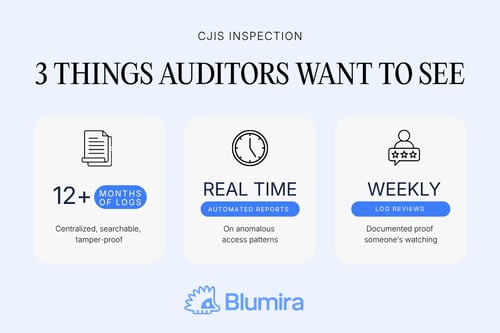 During a CJIS inspection, auditors want to see that you have mature, consistent monitoring in place — not just that you could reconstruct events if you had to. They're looking for:
- Centralized audit logs with retention policies (12+ months)
- Automated alerting on anomalous access
- Evidence that someone is actually reviewing this stuff
A SIEM checks all three boxes. Scattered system logs do not.
The compounding problem: cloud sprawl makes it worse
This gets harder as more CJI moves into cloud-based systems. If your agency is running a cloud RMS, body-worn video platform, or cloud evidence management, those are all additional sources of CJI access logs that need to be captured, centralized, and reviewed. Without a SIEM, each new system adds another silo — and another gap an auditor can flag.
The Austin example is instructive
In 2019, the Texas DPS audited Austin PD and found missing agreements, incomplete logging, and physical security gaps. The kicker? APD knew about most of these issues since 2017 and didn't fix them. The result was mandatory remediation, public city council scrutiny, and a real risk of losing FBI CJI access.
This isn't a rare edge case. It's what happens when compliance work gets deprioritized until an auditor makes it urgent.
The practical takeaway
If you're doing manual log reviews across disparate systems, you already know it doesn't scale. The question is whether you fix it before an audit or after one. The difference in cost — and stress — is significant. More on that in the next post.

The Real Cost of Failing a CJIS Audit
Nobody wants to think about audit failures. But if you're responsible for your agency's security posture, you need to understand what "failing a CJIS audit" actually costs — because it's a lot more than most people expect.
The reactive path is expensive
When a city fails a CJIS audit without proper logging and monitoring in place, they don't just get a warning and some time to fix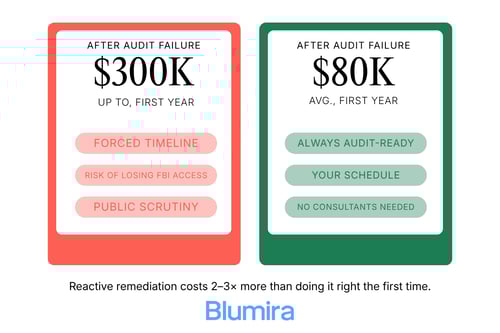 things. They get handed to a remediation process that typically involves:
- Gap assessments from specialized consultants: $25K–$100K, depending on how bad things are
- POA&M tracking: Evidence binders, vendor vetting, mock re-audits — all of it takes staff time and outside help
- Total first-year remediation costs: $150K–$300K for mid-sized cities
That's not a fine. CJIS doesn't issue fines. That's just the cost of getting back into compliance after you've been caught out of it.
Losing database access is the real operational risk
The financial hit is bad. The operational hit can be worse.
If your agency loses NCIC/FBI database access — even temporarily — officers can't run warrant checks, criminal histories, or vehicle queries in the field. The workaround is phone and fax through other agencies. That's a 20–50% efficiency loss for patrol, dispatch, and detectives, every day until access is restored.
For a police department, that's not an abstract risk. It's a direct impact on public safety operations.
What proactive investment actually looks like
A properly implemented SIEM runs $50K–$100K to stand up, with $20K–$30K per year in ongoing maintenance. That's real money — but it's a fraction of what reactive remediation costs, and it comes without the forced timeline, the public scrutiny, or the operational disruption.
The math isn't complicated:
|
Approach |
Cost |
Outcome |
|
Reactive (post-audit failure) |
$150K–$300K + consulting |
Forced timeline, potential access loss |
|
Proactive (SIEM now) |
$50K–$100K + $20–30K/yr |
Audit-ready, continuous monitoring |
Proactive investment typically cuts long-term costs by 40–60% compared to reactive fixes, largely because rushed post-audit implementations carry a premium that planned ones don't.
The consulting costs are entirely avoidable
A big chunk of the reactive price tag goes to consultants who come in after an audit failure to do gap assessments, build remediation roadmaps, and prep evidence binders for re-audits. Cities pay $25K–$100K for this work — covering POA&M tracking, vendor addendum reviews, supply chain vetting, and mock audits just to get back to square one.
That entire expense exists because the logging and monitoring foundation wasn't in place to begin with. A SIEM eliminates most of those gaps before an auditor ever shows up.
The other remediation costs people forget
SIEM isn't the only thing that comes up in a post-audit scramble. Common high-cost items agencies get hit with include:
- MFA and access controls: Full rollout plus identity management upgrades typically run $20K–$75K. Shared accounts and weak passwords are repeat violations, especially since MFA became mandatory in the 2024 CJIS policy updates.
- Encryption and media protection: Encrypting CJI at rest and in transit, plus secure media handling, adds another $15K–$50K.
- Training platforms: CJIS-specific awareness training comes up as a finding in over 70% of audits. Annual platforms run $5K–$25K/year and are entirely avoidable if you're already doing this proactively.
The pattern is the same across all of these: cheap to do right the first time, expensive to fix under audit pressure.
The bottom line for IT and security teams
You probably already know your environment has gaps. The argument for getting a SIEM in front of leadership isn't just technical — it's financial. Framing it as "proactive investment vs. reactive remediation at 2–3x the cost" tends to get attention in budget conversations.
The capability is required either way. The only question is whether you build it on your schedule or the state's.

Why Blumira Makes Sense for Local Government CJIS Compliance
If you've read the previous posts in this series, you already know that CJIS effectively requires centralized logging, automated monitoring, and a year of tamper-proof log retention — and that scrambling to build that out after a failed audit costs two to three times what doing it proactively would have.
The next question is: what tool actually fits a local government environment? For most agencies, the answer isn't an enterprise SIEM that requires a dedicated security team to run. It's something purpose-built for organizations that have real compliance requirements but lean IT staff.
That's where Blumira fits.
It's built around the CJIS controls that actually get agencies in trouble
Blumira maps directly to the CJIS Security Policy sections that auditors focus on. The platform handles the heavy lifting for:
-
Audit and Accountability (Section 5.4): Blumira collects logs across your on-premises and cloud systems — RMS, CAD, endpoints, firewalls, and more — and automatically applies detection rules to surface anomalies. Every alert is populated with the required fields: date, time, system component, event type, user identity, and outcome. That's the exact content CJIS Section 5.4.1.1.1 requires.
-
Weekly log review (Section 5.4.3): CJIS requires that someone reviews audit records at least once a week. Blumira automates the analysis and surfaces prioritized alerts with response playbooks, so your IT staff isn't manually sifting through raw logs — they're reviewing what actually matters.
-
Log retention (Section 5.4.6): CJIS requires a minimum of one year of retained audit records. Blumira includes one year of hot storage on all paid plans, meaning logs are searchable and retrievable on demand — not archived somewhere you'd have to dig through during an audit.
-
Log integrity (Section 5.4.5): Blumira protects audit data from modification or deletion, validates that incoming logs haven't been tampered with, and alerts you if any audit logs are cleared — which is exactly the kind of insider threat or attacker behavior CJIS controls are designed to catch.
It doesn't require a SOC to operate
Most local police departments and county agencies don't have dedicated cybersecurity staff. Blumira was designed with this in mind. The platform deploys via cloud API integrations, takes about 15 minutes a day to manage under normal conditions, and includes pre-built detection rules that cover the events CJIS requires you to monitor.
For agencies that work with an MSP for IT, Blumira supports multi-tenant environments — so your MSP can manage CJIS-compliant monitoring across multiple client agencies from a single pane of glass.
If something critical comes in that your team needs help with, Blumira's security operations team is available for guided support on high-priority issues. For smaller agencies, that's effectively a SOC on call without the staffing cost.
It covers the access control and system monitoring requirements too
Logging is the most commonly cited audit gap, but it's not the only one. Blumira also supports:
- Access Control (Section 5.5): The platform tracks user account activity and provides on-demand or scheduled reporting on account administration — new accounts, deletions, security group modifications, privilege changes. This directly addresses the account management requirements auditors review.
- Remote access monitoring (AC-17): Blumira's agent monitors endpoint activity and can automatically isolate a compromised host from the network — useful for agencies with remote or field access to CJI systems.
- Network and traffic monitoring (SI-4): The platform analyzes inbound and outbound traffic for malware, data exfiltration, and command-and-control communications, and integrates with supported firewalls via dynamic blocklists to block known malicious traffic.
A real example from a local government agency
A technical infrastructure manager at a Midwest county agency described catching a password spraying attack within 20 minutes of it starting — fast enough to pull the affected server off the network and reimage it before any real damage was done. He also noted that his team is required by CJIS to review logs daily, and that Blumira makes that practical in a way manual review never was.
The bottom line for local government IT teams
CJIS compliance doesn't care how big your agency is or how many people are on your IT team. The requirements are the same for a 10-person sheriff's office as they are for a major metropolitan force. What Blumira offers is a way to meet those requirements without hiring a security analyst, standing up complex on-premises infrastructure, or paying an outside consultant to prep your evidence binders every audit cycle.
If your agency is running without centralized log management today, Blumira is worth a serious look — both for what it covers and for what it saves you if an auditor shows up before you're ready. Try Blumira today!
More from the blog
View All Posts
Compliance Security Frameworks and Insurance
7 min read
| May 26, 2025
Customer Story: United Way of Pierce County
Read More
SIEM XDR
4 min read
| November 25, 2024
What is Unified Visibility and What Does it Offer?
Read More
SIEM XDR
7 min read
| June 9, 2025
Customer Story: NetCenter Technologies
Read More