

- Product
Product Overview
Sophisticated security with unmatched simplicityCloud SIEM
Pre-configured detections across your environmentHoneypots
Deception technology to detect lateral movementEndpoint Visibility
Real-time monitoring with added detection & responseSecurity Reports
Data visualizations, compliance reports, and executive summariesAutomated Response
Detect, prioritize, and neutralize threats around the clockIntegrations
Cloud, on-prem, and open API connectionsXDR Platform
A complete view to identify risk, and things operational
- Pricing
- Why Blumira
Why Blumira
The Security Operations platform IT teams loveWatch A Demo
See Blumira in action and how it builds operational resilienceUse Cases
A unified security solution for every challengePricing
Unlimited data and predictable pricing structureCompany
Our human-centered approach to cybersecurityCompare Blumira
Find out how Blumira stacks up to similar security toolsIntegrations
Cloud, on-prem, and open API connectionsCustomer Stories
Learn how others like you found success with Blumira
- Solutions
- Partners
- Resources
February 11, 2026
There is certainly no shortage of security tools promising better visibility, faster detection, and stronger response. However, as the cybersecurity industry has evolved, so has the terminology (SIEM, XDR, MDR, EDR, SOAR, SOC), and many of these acronyms now overlap in confusing ways.
If you are currently researching detection and response solutions, the real challenge is not just understanding definitions or picking the right acronym; it is figuring out which approach, or combination of approaches, will actually deliver the outcomes your team needs. You may also see newer terms like Identity Threat Detection and Response (ITDR) or Threat Detection and Incident Response (TDIR) used to describe more modern security strategies, especially as identity becomes the primary attack surface for modern threats. In practice, these concepts often overlap with today’s XDR platforms, which aim to correlate signals across identity, endpoint, cloud, and network data to support much faster detection and response.
This post breaks down the most common detection and response categories, explains how they differ, and helps you understand where each fits so you can build a security strategy that works for your team and your unique environment.
Table of Contents:
XDR vs. SIEM
What is SIEM?
What is XDR?
MDR vs XDR
What is MDR?
SOAR vs SIEM
What is SOAR?
SOC and SIEM
What is SOC?
EDR vs SIEM
SIEM + XDR
XDR vs. SIEM: Why Extended Detection is the Modern Upgrade
Security Information and Event Management (SIEM) and Extended Detection and Response (XDR) both centralize security data, but they are designed for different primary outcomes. While a traditional SIEM vs. XDR comparison often focuses on log volume, the real differentiator is how your team uses the data to achieve operational resilience.
SIEM platforms focus on collecting and storing logs from across the entire environment to support investigation, forensics, and compliance requirements. They provide broad visibility into system activity and retain the historical data required for audits and regulatory reporting.
XDR platforms prioritize detection and response by analyzing xdr cyber security telemetry across multiple domains, such as endpoints, identity, cloud, email, and networks, to identify active threats and enable faster action. Rather than storing all logs indiscriminately, XDR focuses on correlating high-signal security data to surface real incidents.
The difference between the two is best understood by scope and focus:
- Data scope: SIEM ingests all logs; XDR analyzes curated security telemetry.
- Primary focus: SIEM supports compliance and forensics; XDR drives real-time threat detection and response.
- Automation: SIEM typically relies on external soar tools for response automation, while XDR often includes native detection and response workflows.
In practice, many organizations use SIEM and XDR together—leveraging SIEM for long-term log retention and compliance, while relying on XDR to detect, investigate, and respond to active threats more efficiently.
What Is SIEM (Security Information and Event Management)
SIEM solutions have been around for decades, with capabilities that vary widely by vendor and deployment model. At its core, a SIEM acts as the central log collector for your IT environment, aggregating logs from applications, systems, servers, cloud services, and infrastructure into a single place for analysis.
The primary value of SIEM is visibility and compliance. SIEM platforms help your team investigate security events, perform forensic analysis, and meet regulatory requirements by retaining audit logs for extended periods of time. Many frameworks, such as HIPAA, PCI, and SOC 2, require organizations to store logs for a year or longer, making SIEM a foundational compliance tool.
Traditional SIEMs, however, often come with significant tradeoffs. They are frequently noisy, complex to manage, and heavily dependent on custom detection rules and parsing logic written by skilled engineers. Without constant tuning, a SIEM can become a stagnant log repository rather than a true security tool, making it difficult to identify accurate alerts in a steady stream of false positives. Modern SIEM platforms aim to reduce this burden by offering pre-built detections, automated parsing, and guided response workflows that help your team move faster without needing deep in-house expertise.
Related Content
What Is XDR (Extended Detection and Response)
Extended Detection and Response (XDR) evolved from EDR (Endpoint Detection and Response) to address a simple reality: modern attacks do not stay confined to a single device. XDR connects and correlates security data across endpoints, cloud environments, identity providers, email, and networks to detect and respond to complex, multi-stage attacks.
Unlike SIEM, which focuses on collecting and storing logs for the record, XDR functions as the proactive threat hunter. It analyzes security telemetry across multiple sources to identify patterns that indicate real, high-risk threats. According to Gartner, XDR platforms are differentiated by their deep integration at deployment and their ability to drive detection and response actions, not just analysis.
XDR also addresses gaps left by incomplete or immature SIEM deployments—particularly those used only for log storage or compliance. While xdr definition parameters vary, the goal is always to provide the cross-domain context your team needs to understand the full scope of an attack and respond with confidence. Platforms that combine SIEM and XDR capabilities help you meet compliance requirements while still enabling fast, automated detection and response.
Related Content
MDR vs. XDR: Understanding Service (MDR) vs. Technology (XDR)
When evaluating MDR vs XDR, the primary distinction lies in whether you want to manage security yourself or pay someone else to do it. Both solutions aim to provide high-fidelity threat detection and rapid response capabilities across your digital footprint. MDR functions as a managed service where external analysts monitor your environment around the clock, while XDR is the unified technology platform that empowers your internal team with cross-domain visibility.
Choosing XDR allows your team to maintain full control and build internal expertise, whereas MDR is often chosen by organizations with zero internal security headcount. Many modern teams prefer the XDR approach because it provides the technology needed for operational resilience without the high cost and "black box" limitations of a fully outsourced service.
Related Content
What Is MDR (Managed Detection and Response)?
Managed Detection and Response (MDR) is a service, not a tool. MDR providers combine security technology with outsourced analysts who monitor environments, investigate alerts, and respond to threats on behalf of customers.
MDR is often a good fit for organizations that want to outsource 24/7 monitoring or do not have internal security operations staff. However, MDR introduces specific tradeoffs. External teams often lack the same business and environmental context as your internal staff, which can make it harder to quickly determine whether an alert represents a true risk or a false positive. Without that institutional knowledge, MDR providers may need to rely on constant input from your team during investigations, slowing remediation and creating an ongoing dependency on the service provider.
Related Content
SOAR vs. SIEM: Automating Incident Response Workflows
The SOAR vs SIEM debate often misses the point that these two technologies are designed to work as a single workflow. A SIEM acts as the brain that processes data and identifies suspicious patterns, while SOAR serves as the nervous system that executes automated actions to mitigate those threats. If SIEM identifies a problem, SOAR helps fix it.
While traditional SIEM environments require significant manual effort and a separate SOAR tool to automate response playbooks, modern SIEM + XDR platforms are beginning to consolidate these functions. This evolution means your team can access "SOAR-lite" capabilities—like automated IP blocking or account suspension—directly within your detection platform. By integrating these workflows, you eliminate the complexity of managing multiple tools while still achieving the rapid response times necessary to stop an active breach.
What Is SOAR (Security Orchestration, Automation, and Response)
Security Orchestration, Automation, and Response (SOAR) focuses on connecting tools and automating response workflows. If SIEM identifies a potential problem, SOAR helps fix it. SOAR acts as the “glue” between security tools, defining workflows through playbooks that help teams respond faster and with less manual intervention. For most small-to-medium businesses, a standalone SOAR platform is often overkill. Instead, many modern security platforms embed SOAR capabilities directly into SIEM or XDR workflows, providing necessary automation without adding another complex tool to your stack.
Related Content:
SecOps, Simplified: Part 3 - Security Orchestration, Automation, and Response
At a Glance: SIEM vs. XDR vs. MDR vs. SOAR
|
Feature |
SIEM |
XDR |
MDR |
SOAR |
|
Primary Goal |
Compliance & Visibility (Log collection) |
Threat Detection (Real-time action) |
Expert Service (Outsourced monitoring) |
Efficiency (Automated workflows) |
|
It Is A... |
Tool (Software) |
Tool (Platform) |
Service (People) |
Tool (Software) |
|
Best For |
Meeting audits & long-term investigation |
Stopping active attacks & ransomware |
Teams with zero internal security staff |
Large SOCs drowning in alerts |
|
Gap |
Can be noisy; requires tuning |
Lacks log retention for compliance |
Expensive; "Black Box" visibility |
Complex to build playbooks |
SOC and SIEM: The Team, the Technology, and the Operating Model
Understanding the relationship between SOC and SIEM is essential for building a functional security program. A SOC (Security Operations Center) is the actual team of professionals responsible for the strategy and execution of your security operations, while the SIEM is the primary tool they use to gain visibility. You can think of the SOC as the pilot and the SIEM as the cockpit instrumentation that provides the data needed to fly the plane safely.
For small-to-medium businesses, the goal is often to achieve "SOC-like" outcomes without the massive expense of hiring a dozen full-time analysts. By leveraging a modern SIEM platform that automates the heavy lifting of log parsing and threat hunting, your existing IT team can function as an effective SOC, focusing on strategic decision-making rather than manual data entry.
Related Content:
What Is SOC? (Security Operations Center)
A security operations center is run by a security operations (SecOps) team that continuously monitors, analyzes and responds to security incidents. Many small or mid-sized organizations cannot afford to keep a full in-house SOC on staff, as it is incredibly costly and time-intensive to train, hire and maintain experienced security professionals. The industry has responded by creating managed detection and response (MDR) services, or more effectively, by developing unified platforms that allow lean teams to perform SOC-like functions without massive headcount expansion.
Related Content:
EDR vs. SIEM: Limiting Detection to the Endpoint
The comparison of EDR vs SIEM highlights the difference between seeing deep into a single device and seeing across your entire network. EDR provides an incredible level of detail regarding what is happening on a laptop or server, such as file changes and process executions. However, a SIEM provides the necessary context by connecting those endpoint events to cloud logins, firewall traffic, and identity changes.
If an attacker uses a compromised password to log into your Microsoft 365 environment, your EDR will remain silent because no malware was used on the device. A SIEM captures that identity risk, allowing you to see the full picture. For modern protection, your team needs both: the device-level depth of EDR and the environment-wide breadth of a SIEM to ensure no blind spots remain in your defenses.
New Related Content
SIEM vs. ITDR: Identity-Focused Detection
Security Information and Event Management (SIEM) and Identity Threat Detection and Response (ITDR) address different aspects of detection. SIEM provides broad visibility across logs, including identity-related events, and supports investigation, forensics, and compliance. ITDR focuses specifically on identity-based threats, such as suspicious authentication behavior, privilege escalation, and misuse of identity providers.
Key differences include:
- Scope: SIEM ingests logs across the environment; ITDR analyzes identity-specific signals.
- Focus: SIEM supports investigation and compliance; ITDR prioritizes identity-driven threat detection.
- Role: ITDR typically complements SIEM by adding deeper identity context rather than replacing centralized logging.
Related Content
What Is EDR? (Endpoint Detection and Response)
EDR (endpoint detection and response) continuously monitors endpoints (desktops, laptops, servers) to detect malicious behavior or malware. EDR uses behavior-based detection to spot emerging attacks such as advanced persistent threats (APTs) and fileless malware. One drawback to relying on EDR alone is that the software is limited to only endpoints. For a more holistic view of modern hybrid environments, you need to collect and correlate data from many different sources, including identity and cloud providers.
Related Content
EDR vs. XDR: Endpoint vs. Extended Scope
When looking at XDR vs EDR, the key difference is scope. EDR focuses exclusively on individual endpoints, providing deep visibility into device-level activity. XDR expands this detection and response beyond the endpoint by correlating security signals across identity providers, cloud workloads, email, and networks. While EDR delivers depth at the device level, XDR provides the cross-domain context needed to understand the full scope of a multi-stage attack.
Related Content:
SIEM + XDR: The False Choice and the Unified Solution
The common "Vs." debate is actually a false choice. To achieve true operational resilience, you need SIEM capabilities for compliance, XDR for real-time protection, and MDR-level support for technical expertise.
Blumira offers a unified security operations approach that delivers these outcomes without the complexity of managing multiple disconnected tools:
- SIEM + XDR: Get your compliance logs and automated threat blocking in one place.
- Automated SOAR: Response playbooks are built directly into the platform, so you don't need to purchase a separate SOAR tool.
- SecOps Support: Our team acts as your expert support when things go wrong, empowering the team you already have rather than replacing them.
Stop juggling acronyms and start building internal capability. Whether you need to meet a compliance deadline or stop a ransomware attack in its tracks, a unified platform provides the foundation you need to grow with confidence.

More from the blog
View All Posts
Security Trends and Info
4 min read
| February 11, 2024
So you think you need a SOC?
Read More
SIEM XDR
5 min read
| December 11, 2024
Manual vs Automated Security Visibility for Resource-Constrained Teams
Read More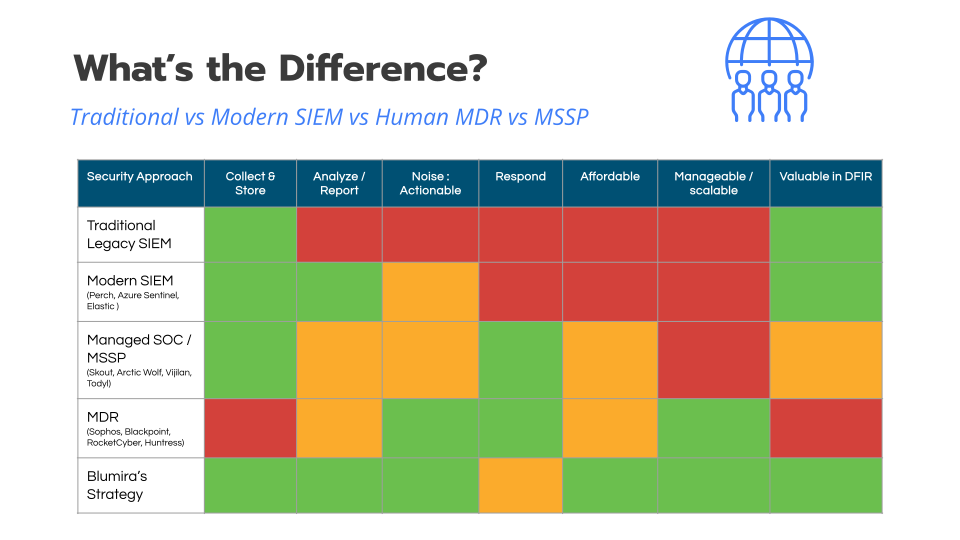
SIEM XDR
10 min read
| September 11, 2024
Traditional vs Modern SIEM vs Human MDR vs MSP
Read More